|
Political issues
The play had to tackle some difficult political issues to be worth
its salt. The matter of the State Rail Authority contracting outside
companies to do work which could have been done by its own workers a
good example. "The men wonder why work gets sent out to private
enterprise," said Tony Helou. "They see their work decreasing,
yet work is still being sent out They also have to stay in their jobs,
but
they hate it. Their lives are owned 95 percent by the railway. The Lebanese
workers feel this particularly, because they are used to being able
to go home at lunchtime, see their kids, whereas here they are trapped
from 7.30 am to 4.00 pm and they hardly see their families." A
fine balance was demanded as the whole project walked a tortuous path
between the company's vision of things, the union organisers' opinions
and management's concern that the final production didn't overstep the
mark. Workers themselves were not entirely clear about how the politics
surrounding their jobs should be worked out. As Anne-Marie Wiles found
out, many didn't really know how it felt to represent the union until
circumstance forced them into it. She said: I asked one organiser how
he got to be shop steward and he told me 'Because no one else would
take on the job.' It's a thankless task. Yet middle management there
is promoted by seniority, not by skill."
Christian Manon said the migrant workers committee described themselves
as the modern slaves." "They said they had 'invisible chains',"
Christian said, "Our chains are at home - our houses, cars and
so on .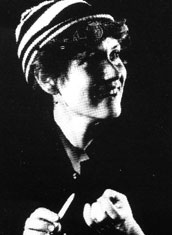
The interesting comparison between the workers from Sidetrack and Chullora
was that they all shared the need to establish some foothold for themselves
in that environment. Tony Helou observed: "Everyone has brought
something in from home, trying to create some sort of familiar feeling.
There was one guy who was making a copper beaten mermaid to put on his
locker - and he damn well did it all right." Christian Manon saw
the workers' arrangement of a nude photograph display as a distraction
from the ugly workplace. And in the private locker space were the most
virginal of all the photographs.
Michelle Millner commented that one of the young female apprentices
was offended by such photographic displays, but she didn't really let
it worry her because she was determined to make a career as an engineer.
The same went for the dirty environment and clothes.
|
 When
it came to the issue of the arrival of new technology, the workers had
mixed responses. Most did not have immediate fears about new technology
taking their jobs, but they did worry about their children and the prospect
of them facing unemployment. When
it came to the issue of the arrival of new technology, the workers had
mixed responses. Most did not have immediate fears about new technology
taking their jobs, but they did worry about their children and the prospect
of them facing unemployment.
Although there was a pride in the work that the place had turned out
over the years, there was no real romance about the "Good old days
of steam", one of the themes used for a song in the play. "They
said it was no fun shovelling seven tons of coal on the old train from
Sydney to Newcastle:' Dallas Lewis said.
Assessing the project
If Sidetrack made a miscalculation with this project, it was most likely
underestimating how many of their traditional ideas about performance
could have been left at home. Then, when the difficulties of adjusting
overnight to an alien workplace had been experienced, the end result
could have been reviewed once more from the outside perspective, to
see if the product offered the workers an honest and effective reflection
of the culture of their workplace, or classified issues affecting the
future of workers in that environment.
Other approaches, such as using workers themselves to take part in the
performance, or to produce the script and to participate more in the
direction or production of the play, could be tried.
However the production is mounted, one aspect of Sidetrack's work at
Chullora underlines an essential aspect of art and working life projects.
They must not be presented in a vacuum - the history of the work and
the workplace involved plays a vital part in its contemporary "feel"
and affect on the workers.
Chullora is a particularly strong example of the workplace having a
history of its own, going back to 1920s when union militants were sent
there to keep them away from trouble spots, through the 1930s and the
war years when a whole community sprang up around the site and the Cooks
River behind it. These facts help provide a perspective that highlights
how people will always make a cultural impression wherever they gather,
for whatever reason.
Sidetrack's director and actors are very critical of their own work,
as has been indicated here. But alongside all of the self criticism
and lessons learned, it must be acknowledged that the project was extremely
successful!
It has provided a model of co-operation between theatre workers and
workshop workers, and has produced a work which, in performance, was
received with recognition and acclamation. It should be seen as a springboard
from which many more innovative Art and Working Life projects will be
seen to be possible.
|