Relating to the work environment
Sidetrack's performers found communicating with people on the job was
not an easy task.
"They suppressed their feelings a lot when we talked to the workers,"
said Michelle Millner, who played Alex the sacked apprentice in the play.
It was hard to know what people really thought."
"We were really confronted by the conditions they had to work in,"
said Don Mamouney. I usually have a feeling that I've got a grip on the
thing, but with this one I didn't. We lost a lot of focus moving into
a completely strange environment."
Taking time to weigh up the forces at work in the workplace was also essential.
"We thought we were going to go into Chullora and 'suss out the issues'
", said Anne-Marie Wiles, who played George the workshop foreman
in the play. "But there are 3,000 people at Chullora Workshops, all
very different from one another, and in an environment which we found
very difficult to relate to. In five weeks it turned out we were not 'taking
on' the workplace, but we were taking on the whole capitalist structure.
And the whole time it was as if we were waiting for a moment to arise
when we could grasp it!'
One answer would seem to be additional time, and therefore additional
funding, for such projects. But even given the advantage of those extras,
artists still need to remember the major lesson that, as Don Mamouney
said, "You can't work from the mainstream model. There is normally
a four week rehearsal period for productions, whereas we had four weeks
to discover, write and produce the whole thing."
Interacting with the workers
"The whole Loco production came about because of the work area stewards
and
shop stewards at Chullora," Don said.
"People like Brian Dunnett and others of the Combined Area Stewards
Committee, whose enthusiasm made the whole thing possible."
That's not to say things happen easily.
Often the actors had priorities that differed from those of the workers'
representatives, who may just have wanted an extended chat right when
intense rehearsal sessions were due to start. But Sidetrack's team learnt
a lot from union organisation at Chullora; for example, the workers have
had ever since the second world war a union-management agreement for an
extra half hour added to the lunch-hour once a month for "cultural
activities". Films are screened, experts from universities and elsewhere
come in to give talks on topics of interest, and Sidetrack got to "tour"
is production of Loco around the various canteens on the Chullora site.
Workers who saw the most of Sidetrack's members helped out a lot with
talk about their attitudes, conditions and aspirations. They also pitched
in to set up the lighting and organising space for performances in the
canteens. This came about because of the patient basis on which Sidetrack
and union organisers approached each other from the start.
|
Shaping the play
Anne-Marie Wiles said she thought the decision at the last minute to
run a few final rehearsals away from Chullora, back at Sidetrack's base
in Marrickville, helped improve the final product. "We needed to
take it away from there for a while to polish it before the opening performance,"
she said.
"Incorporating music, feeding back the dialogue, and consultations
about the sets - they all needed more time," said Don Mamouney. "But
without doubt, actors are affected by trying to understand people's lives,
so their emotional rhythms will follow the influences they come across
- and that all requires extra time to work through!'
The structure of the play itself was a vital factor in the success of
the project. A subtle combination of humour, sarcasm, realism and exageration
was able to produce both entertainment and effective drama. The pace of
the show was important, especially since it was shown to workers in different
canteens during their lunch-hour, a time when people want to relax.
The final script proved itself during these lunch-hour performances. Workers,
munching away at their lunch or enjoying a drag on a cigarette, would
suddenly burst out laughing, or nudge each other as a characterisation
came home to them. As union rep. Mark Helson put it: "The workers
would pay to come and see the show again. The jokes about life on the
railways, the way old foreman George gets sent up, we'd like to be able
to bring our families to see this, so they can come and see what it's
like for us at work year after year."
Many of the workers expressed similar sentiments, as if it took a cultural
event to remind them that their week-in, week-out working lives were significant.
Various characters in the play raise issues which are hard to confront
in person. For example, race relations at work - the way individuals take
advantage of non English speakers - is sent up when Abdu is told to fetch
the wrong part from the store and, when he finds out a joke has been played
on him, his outburst illustrates how cheap humour can grind away at a
person's soul.
The character of Kenny Walker, a poser who is trying to convince his high
society girlfriend that he works for an advertising agency and drives
a BMW, raises the question of whether some workers are really ashamed
of what they are and what they do.
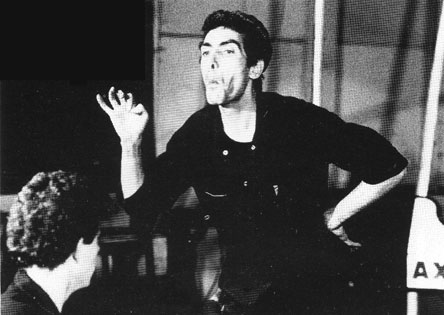
The show itself was created from the bare stage essentials, with actors'
movements helping to keep the audience following the dialogue.
The play was performed in a simple square area, usually in one of Chullora's
canteens or in the workshops themselves. A scaffold-type structure formed
the imaginary locomotive and acted as the stage for most of the musical
numbers in the play.
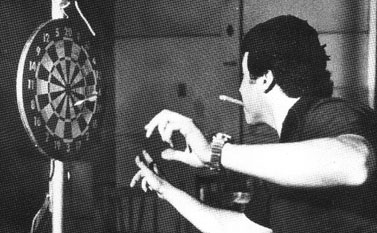
Two other corners of the square had simple chairs, dart board and 44 gallon
drum as props; the fourth corner acted as entry/exit point. Workers usually
sat round most of the performance space, which worked well to create an
intimacy appropriate for a play about their own experiences.
Lighting effects were used to highlight points in the play, helping to
bring more drama out of the simple stage setting
|